
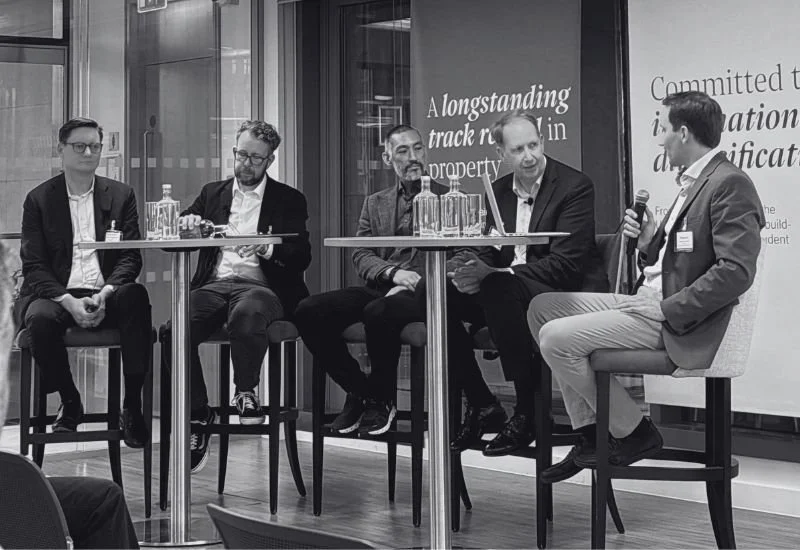
Senior leaders from across UK real estate, transport and infrastructure came together in London for the Realcomm CIO & PropTech Forum in December; a senior-level forum focused on how digital strategy, data and emerging technologies are influencing real-world decisions across the built environment.
The closed-door event prioritised practical experience over theory, with open discussion on what digital transformation looks like in practice for complex asset owners and operators. It brought together CIOs and senior decision-makers from across commercial real estate, transport and the wider built environment to share experience and insight on topics ranging from data-driven decision-making and AI adoption to operational resilience, workplace strategy and organisational readiness for change.
Discussions reflected a growing convergence between real estate and infrastructure, with contributors highlighting common challenges around legacy systems, fragmented data and the need to align technology investment with long-term asset performance. Rather than focusing on specific products or platforms, the emphasis was on practical lessons from live programmes, and on the role of leadership in embedding digital capability across complex organisations.
Andrew Waller, of Remit Consulting, spoke to the forum about the importance of reliable workplace and operational data in a market where occupiers and asset owners are under increasing pressure to justify space, cost and performance decisions.
“Across the UK real estate market, we are seeing much greater scrutiny on how buildings and workplaces actually perform in use,” he commented, adding: “Technology has a critical role to play, but only if it is grounded in clear objectives and good data. The conversations at the forum reflected a growing maturity in how organisations are approaching digital change, moving away from experimentation and towards informed, evidence-led decision-making.”
The infrastructure perspective was provided by Network Rail, with a focus on how large, nationally significant asset portfolios utilise technology to enhance operational outcomes and long-term resilience.
Network Rail’s Vince Herrera-Leon said, “For infrastructure owners, digital transformation is not abstract. It directly affects safety, reliability and value for money. Many of the challenges discussed, from data integration to organisational change, are shared with the real estate sector. Forums like this are valuable because they allow different parts of the built environment to learn from each other in a very practical way.”
Kevin Kincaid, Group Transformation Director at Grosvenor, who hosted the event, said, “One of the most valuable aspects of bringing this group together was the chance to step back from individual projects and look at the common challenges we are all dealing with. Having open, senior-level conversations like this helps move the industry towards more informed, joined-up approaches rather than isolated solutions.”
The forum also underlined the growing importance of cross-sector dialogue as technology agendas increasingly overlap. Participants noted that issues such as AI governance, cybersecurity, skills and change management are now central to both property and infrastructure strategies, particularly in the context of ageing assets and long-term investment horizons.
Commenting after the event, Howard Berger, Managing Partner and SVP, Programs at Realcomm, said: “The quality of discussion at the London CIO & PropTech Forum was extremely high. What stood out was the openness with which senior leaders shared real experiences, including what has worked and what has not. That level of candour is essential if organisations are to make meaningful progress with digital transformation. We are building on this momentum as we look ahead to Realcomm 2026, which will take place in San Diego on June 3–4, 2026.”
The London event forms part of Realcomm’s wider global programme, designed to support senior real estate and infrastructure leaders in navigating the strategic, operational and technological challenges shaping the future of the built environment.